
- PLATFORM
- Our technology
A barcoded duplex chemistry that separates real signal from background error.
For the visitor who already knows tumour-informed ctDNA monitoring and wants to see the underlying chemistry, the validated performance and the limits we are open about. No marketing layer.
Three things our technology does that conventional technology does not.
Single-molecule duplex barcodes
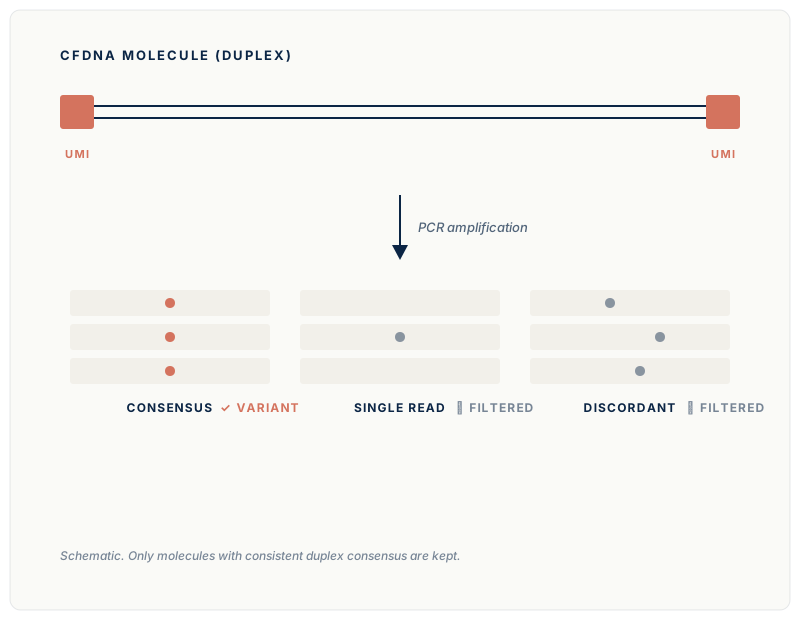
Each original cfDNA molecule gets a unique, double-stranded barcode before any amplification. That means every read can be traced back to the exact starting molecule and its complementary strand.
Consensus-based error suppression
Variants are called only when they appear consistently across multiple PCR copies and on both strands of the original molecule. Polymerase errors and sequencing artefacts are filtered out by design.
Tumour-informed personalised panels
The panel is built from the patient's own tumour profile, not a fixed gene list. That focuses sensitivity on the variants that matter for that specific tumour, and keeps the per-sample cost workable.
What the platform delivers, in numbers a scientist can use.
LIMIT OF DETECTION<0.001 VAF |
input requirement10-50 ng cfDNA |
sequencing platformIllumina |
| Single-molecule resolution. Published in Nature Protocols. Validated on cfDNA panels across paediatric, surgical and translational cohorts. | Low input by design. Works with small plasma volumes, paediatric samples and early-stage cohorts where most platforms run out of starting material. |
Runs on all Illumina sequencers. LabSuite kits are validated on the platform most European laboratories already operate. No proprietary box to buy. |
Five steps from plasma to clinical report.
The same workflow whether you send samples to our lab or run SiMSen-Seq in-house on LabSuite. Click any step for what happens, what we need, and what you get back.
Sample collection and cfDNA isolation.
Sequencing on Illumina or Element platforms. The Simsen pipeline collapses reads into duplex consensus families, removes single-strand and discordant artefacts, and calls variants only where signal is consistent across the family. Raw BAM and FASTQ are delivered alongside the call set.
Run our pipeline, run yours, or run both. The data is open by design.
.
WHAT WE NEED
PLASMA
4-10 mL, stabilised collection tube
TUMOUR
FFPE block or fresh tissue, for panel design
TURNAROUND
Sample receipt within 5 working days
Personalised panel design from the patient's tumour.
Tumour exome or targeted sequencing identifies the patient-specific variants worth tracking. The panel typically covers 20-50 personalised SNV targets per patient, weighted toward clinically actionable variants and tumour markers that drift with treatment.
Panel design takes about two weeks; once the panel is built, subsequent plasma samples run on a standard turnaround.
What you get
Panel size
20–50 personalised targets
Design time
~2 weeks from tumour sample
Reusable
Same panel across all longitudinal plasma points
SiMSen-Seq library preparation.
Duplex molecular barcoding before any amplification. The library is built so every original cfDNA molecule has a unique, traceable tag, and both strands of the duplex are kept through the workflow. This is what makes the consensus error suppression in step 4 possible.
LabSuite ships the library prep kit and protocol so the same chemistry runs in your laboratory exactly as in ours.
KIT Contents
Format
LabSuite distributed kit or in-lab
Hands-on time
~4 hours per batch
Batch size
Up to 96 samples
Sequencing and consensus calling.
Sequencing on Illumina platforms. The Simsen pipeline collapses reads into duplex consensus families, removes single-strand and discordant artefacts, and calls variants only where signal is consistent across the family. Raw BAM and FASTQ are delivered alongside the call set.
Run our pipeline, run yours, or run both. The data is open by design
OUTPUT
RAW DATA
FASTQ + BAM, customer-owned
PIPELINE
Open, documented, reproducible
COVERAGE
10,000× consensus, typical
Clinical report and longitudinal view.
Report built for the people reading it: clinicians, study teams, principal investigators. Each variant is shown with VAF, clinical rationale and trajectory across longitudinal samples. Resistance markers and clonal evolution are surfaced where present.
Reports are available as PDF and can be returned via API into your clinical or trial database
DELIVERY
TURNAROUND
10-15 working days, standard plasma
FORMAT
LANGUAGES
English; per-trial localisation on request
TECHNOLOGY
SiMSen-Seq, the science under the hood.
Barcoded duplex sequencing, error suppression and the sample-to-result workflow, with performance data.
COMPARISON
SNV vs SV vs tumour-naive.
The three families of tumour-informed monitoring, side by side, and a four-question decision guide.
DELIVERY
Full-service lab or LabSuite kits.
The two delivery models, the trade-offs on cost, control, turnaround and capability.
Where our technology is strong, and where it is not.
An honest read on the platform. Sensitivity below 0.001% VAF is real and validated. There are sample types and clinical questions where another approach is the right choice. We will tell you which.
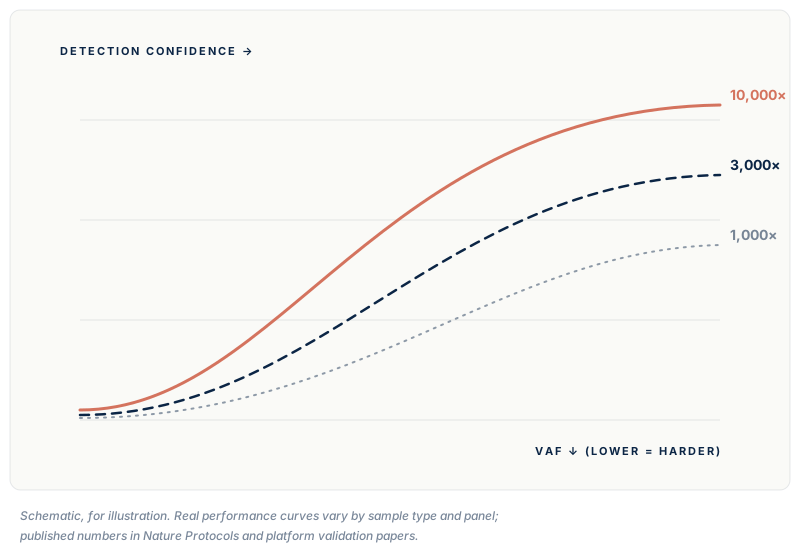
Sensitivity scales with consensus depth.
The chart on the right shows expected detection confidence as a function of variant allele frequency, across three consensus depth tiers. At 10,000× consensus, the platform resolves single-molecule signal in the parts-per-million range.
For very high-burden cases, lower consensus depth is sufficient and faster. For minimal residual disease and paediatric work, depth is the right lever.
When SiMSen-Seq is not the right tool
If no tumour tissue exists, or sensitivity is secondary, a tumour-naive panel may serve you better.
Tumour-informed monitoring requires a tumour sample for panel design. If the case is post-mortem, pre-biopsy or otherwise tissue-absent, a fixed tumour-naive panel is the correct call. We will say so, and we maintain comparisons with the leading alternatives on the Methodology page rather than hiding them.
Validated where it matters: in independent journals.
A selection of the foundational and applied publications. Filter the full list on the Evidence page.
FOUNDATIONAL CHEMISTRY
SiMSen-Seq: simple, multiplexed, sensitive sequencing for the detection of low-frequency variants.
Stahlberg A, et al. Nature Protocols, 2017
COMPARISON
SNV vs SV vs tumour-naive.
The three families of tumour-informed monitoring, side by side, and a four-question decision guide.
FOUNDATIONAL CHEMISTRY
SiMSen-Seq: simple, multiplexed, sensitive sequencing for the detection of low-frequency variants.
Stahlberg A, et al. Nature Protocols, 2017
COMPARISON
SNV vs SV vs tumour-naive.
The three families of tumour-informed monitoring, side by side, and a four-question decision guide.
Speak to our scientific team.
A real human, in CET/CEST time zone, who has run samples like yours.