
- PLATFORM
- Our technology
A barcoded duplex chemistry that separates real signal from background error.
For the visitor who already knows tumour-informed ctDNA monitoring and wants to see the underlying chemistry, the validated performance and the limits we are open about. No marketing layer.
✓ 0.001% VAF detection · Works on all Illumina sequencers · Open pipeline
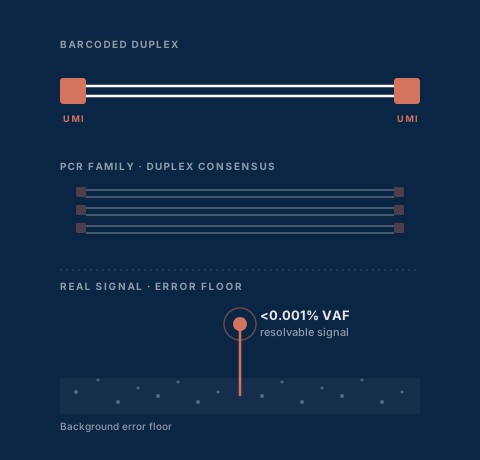
Three things our technology does that conventional technology does not.
Single-molecule duplex barcodes
Each original cfDNA molecule gets a unique, double-stranded barcode before any amplification. That means every read can be traced back to the exact starting molecule and its complementary strand.
Consensus-based error suppression
Variants are called only when they appear consistently across multiple PCR copies and on both strands of the original molecule. Polymerase errors and sequencing artefacts are filtered out by design.
Tumour-informed personalised panels
The panel is built from the patient's own tumour profile, not a fixed gene list. That focuses sensitivity on the variants that matter for that specific tumour, and keeps the per-sample cost workable.
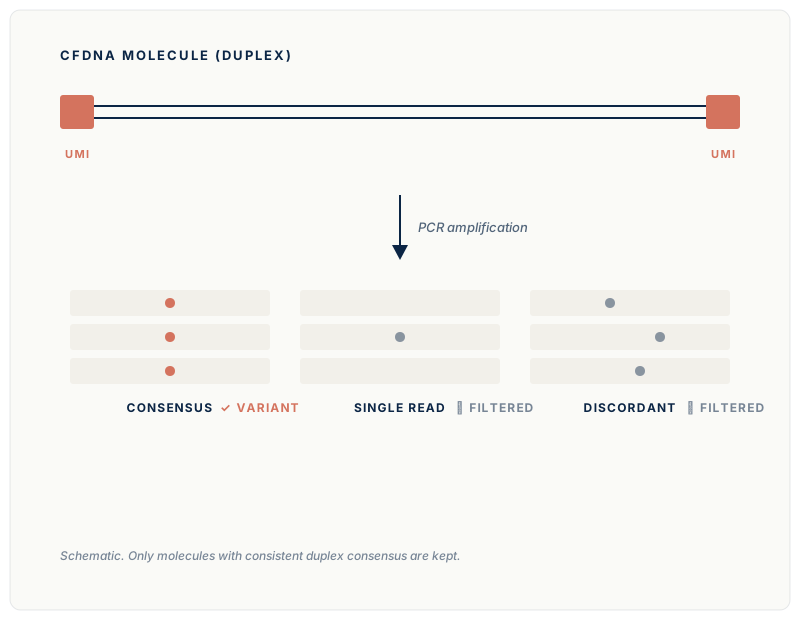
What the platform delivers, in numbers a scientist can use.
LIMIT OF DETECTION<0.001 VAF |
input requirement10-50 ng cfDNA |
sequencing platformIllumina |
| Single-molecule resolution. Published in Nature Protocols. Validated on cfDNA panels across paediatric, surgical and translational cohorts. | Low input by design. Works with small plasma volumes, paediatric samples and early-stage cohorts where most platforms run out of starting material. |
Runs on all Illumina sequencers. LabSuite kits are validated on the platform most European laboratories already operate. No proprietary box to buy. |
Five steps from plasma to clinical report.
The same workflow whether you send samples to our lab or run SiMSen-Seq in-house on LabSuite. Click any step for what happens, what we need, and what you get back.
What we need to start.
To build a personalised panel we need either tumour material, fresh-frozen or FFPE, or an existing tumour mutational profile from your own sequencing data. In both cases we strongly recommend a matched germline control, typically whole blood, so somatic mutations can be confidently separated from inherited variants.
The richer the mutational profile, the more variants we can track in plasma, and the more sensitive the resulting ctDNA analysis. Detailed shipping conditions and minimum inputs are on the sample requirements page.
WHAT WE NEED
TUMOUR
FFPE or fresh-frozen tissue
OR EXISTING DATA
VCF, spreadsheet or FASTQ
GERMLINE CONTROL
Matched whole blood, EDTA, strongly recommended
A panel designed around your patient's tumour.
We design, manufacture and validate a personalised SiMSen-Seq panel covering up to 50 patient-specific somatic variants, selected from the tumour profile. Clinically actionable variants and drug-resistance markers can be added on request.
The same panel is then reused for every subsequent plasma sample from that patient, which keeps ongoing ctDNA monitoring fast and affordable across the entire patient journey.
TURNAROUND AND OUTPUT
FAST TAT
Mean 3 weeks from sample receipt
STANDARD TAT
Mean 3 weeks from sample receipt
PANEL
Up to 50 personalised targets, reusable across all timepoints
Ultrasensitive ctDNA analysis, run end-to-end in our lab.
Plasma samples are analysed on the personalised panel using SiMSen-Seq, our duplex-barcoded amplicon chemistry. In our lab we handle the full workflow: cfDNA extraction, library preparation with unique molecular identifiers (UMIs), targeted sequencing and consensus-based bioinformatics that suppresses background error to single-molecule level. You ship plasma in stabilised collection tubes, we return data and report.
The original SiMSen-Seq publication established sensitivity at 0.1% VAF. In our internal validation, presented at the ctDNA Symposium in Aarhus, May 2026 (Rostamzadeh et al.), we demonstrated a Limit of Detection at 95% confidence (LoD95) of 0.01% VAF, with individual variants detected as low as 0.001% VAF (10 parts per million).
SERVICE DETAILS
WHERE
Our lab in Gothenburg, Sweden
You send
Plasma in stabilised collection tubes
FAST TAT
Mean time: 7 working days
STANDARD TAT
Mean time: 12 working days
Ultrasensitive ctDNA analysis, run in your own lab with Simsen LabSuite.
Simsen LabSuite delivers the entire SiMSen-Seq workflow to your own NGS laboratory. We ship the personalised panel, all required reagents, and our bioinformatic software, so library preparation, sequencing and consensus calling run in-house with identical chemistry and identical performance to our full service. Your team retains end-to-end control of samples and timing, and the data never leaves your environment.
Performance is anchored to the same validation as the full service: LoD95 of 0.01% VAF, with individual variants detected as low as 0.001% VAF, as presented at the ctDNA Symposium in Aarhus, May 2026 (Rostamzadeh et al.).
SERVICE DETAILS
WHERE
Your own NGS laboratory
WE SHIP
Personalised panel, reagents, bioinformatic software
YOU RUN
SiMSen-Seq in-house, same chemistry
WHERE
Illumina sequencing platforms
SUPPORT
Onboarding, protocol training, ongoing bioinformatics support
A clinical-grade ctDNA report.
Every analysis is delivered as a comprehensive PDF report covering mutant molecules per mL of plasma (MM/mL), variant allele frequency (VAF), and the amount of cfDNA used. Each variant is shown individually and aggregated as a single ctDNA load value per sample.
A longitudinal timeline across all samples from the same patient is included as standard, so MRD status, treatment response, clonal evolution and emerging resistance are visible at a glance. All raw data is shared in parallel via secure file transfer.
WHAT YOU RECEIVE
FORMAT
PDF report, full raw data via secure transfer
PER VARIANT
MM/mL, VAF, cfDNA used
PER SAMPLE
Aggregated ctDNA load value
LONGITUDINAL
MTimeline across all timepoints
Built once, tracked over time.
With the personalised panel validated, every subsequent plasma sample runs on the same fast, standardised workflow. New timepoints are added to the existing longitudinal report, so MRD status, treatment response and emerging resistance are tracked with consistent, comparable data across the entire patient journey.
The investment in panel design compounds over time: each additional timepoint is faster, cheaper, and more clinically informative than the last.
WHY IT MATTERS
COST
Lower per-sample cost as the patient journey progresses
SPEED
Standard TAT for all follow-up samples
COMPARABILITY
Same validated panel across every timepoint
INSIGHT
Clonal evolution and resistance visible as they emerge
Where our technology is strong, and where it is not.
An honest read on the platform. Sensitivity below 0.001% VAF is real and validated. There are sample types and clinical questions where another approach is the right choice. We will tell you which.
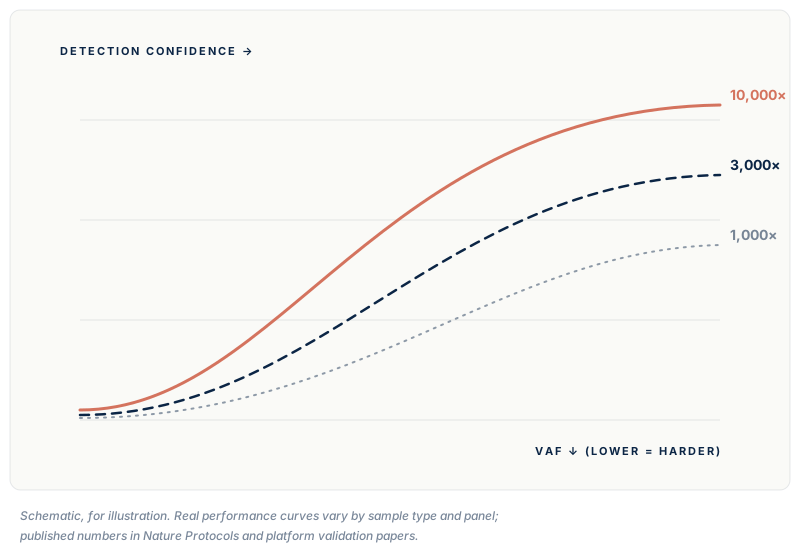
Sensitivity scales with consensus depth.
The chart on the right shows expected detection confidence as a function of variant allele frequency, across three consensus depth tiers. At 10,000× consensus, the platform resolves single-molecule signal in the parts-per-million range.
For very high-burden cases, lower consensus depth is sufficient and faster. For minimal residual disease and paediatric work, depth is the right lever.
When SiMSen-Seq is not the right tool
If no tumour tissue exists, or sensitivity is secondary, a tumour-naive panel may serve you better.
Tumour-informed monitoring requires a tumour sample for panel design. If the case is post-mortem, pre-biopsy or otherwise tissue-absent, a fixed tumour-naive panel is the correct call. We will say so, and we maintain comparisons with the leading alternatives on the Methodology page rather than hiding them.
Validated where it matters: in independent journals.
A selection of the foundational and applied publications. Filter the full list on the Evidence page.
FOUNDATIONAL CHEMISTRY
SiMSen-Seq: simple, multiplexed, sensitive sequencing for the detection of low-frequency variants.
Stahlberg A, et al. Nature Protocols, 2017
PAEDIATRIC SARCOMA
Plasma ctDNA monitoring with nine months of lead time over clinical relapse.
Ek S, et al. Cancers, 2024.
PAEDIATRIC NEUROBLASTOMA
Personalized circulating tumor DNA analysis for sensitive disease monitoring and detection of relapse in neuroblastoma.
Rahmqvist, et al. Biomarker Research, 2024
BREAST CANCER
Integration of personalised ultrasensitive ctDNA monitoring of patients with metastatic breast cancer to reduce imaging requirements.
Mouhanna, et al. IJC, 2024
Speak to our scientific team.
A real human, in CET/CEST time zone, who has run samples like yours.