
- EVIDENCE
- Paediatric solid tumours
See relapse in a child's sample months before imaging can.
Paediatric solid tumours give you the least to work with: low tumour burden, low blood volume, and allele frequencies where most ctDNA platforms return false negatives. Ultra-sensitive SiMSen-Seq is built for exactly that regime. Here is what it lets paediatric oncology and translational teams do that they currently cannot, and the evidence behind it.
Why paediatric solid tumours are the hardest place to find ctDNA.
The biology that makes these cancers so urgent is the same biology that makes them invisible to most monitoring platforms.
Why paediatric solid tumours are the hardest place to find ctDNA.
The biology that makes these cancers so urgent is the same biology that makes them invisible to most monitoring platforms.
Low tumour burden
Early-stage and residual paediatric disease sheds tiny quantities of tumour DNA. At the allele frequencies that result, conventional ctDNA assays run out of resolution and start returning false negatives, exactly when an early call matters most.
Small blood volumes
You cannot draw an adult tube of blood from a child. Less plasma means less cfDNA to start from, so an assay that needs high input simply cannot be run on the sample you have.
Rare, heterogeneous tumours
Paediatric solid tumours are biologically diverse and individually rare. Fixed, off-the-shelf gene panels rarely cover the variants that matter for a given child's tumour.
Imaging arrives late
Radiological surveillance only detects relapse once disease is large enough to see. By then the therapeutic window has narrowed, and the child has carried undetected disease for months.
Four things ultra-sensitive ctDNA makes possible in paediatric oncology.
Each one is a clinical or research outcome first. The chemistry that delivers it is on the technology page.
01
Catch relapse before it is visible
Parts-per-million detection surfaces molecular relapse while tumour burden is still tiny. In published work on ALK-driven neuroblastoma, ctDNA monitoring provided around nine months of lead time over clinical relapse (Ek et al., Cancer Research Communications, 2024).
That earlier window is time to intervene, to change therapy, or to confirm response before committing to it.
02
Run the assay on the sample you actually have
A low-input design works from 10 to 50 ng of cfDNA, the small plasma volumes that paediatric and early-stage cohorts realistically provide. You are no longer choosing between a big blood draw and no result.
03
Track the variants that matter for that child
A tumour-informed, personalised panel of up to 50 patient-specific somatic variants is built from the child's own tumour profile, not a generic gene list, then reused at every timepoint.
Sensitivity is focused where it counts, and follow-up samples stay fast and affordable.
04
Follow the whole journey on one timeline
Every plasma sample is added to a longitudinal report showing minimal residual disease status, treatment response, clonal evolution and emerging resistance, with full raw data for your own analysis.
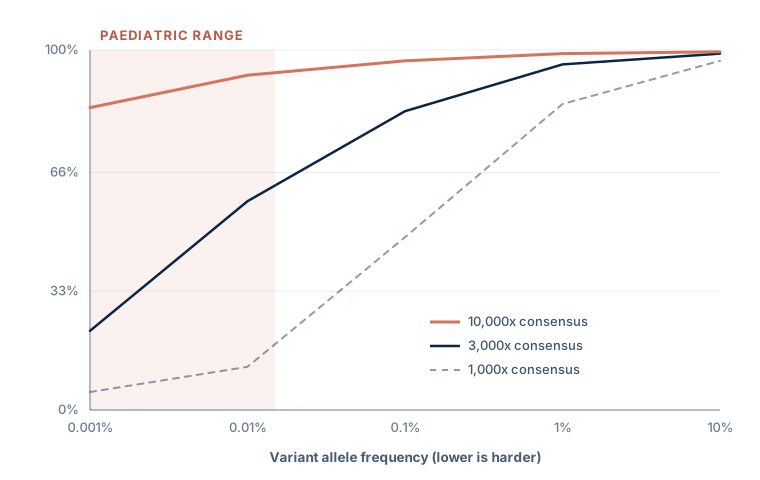
The numbers behind "ultra-sensitive", in the range paediatric samples live in.
Detection confidence rises with consensus depth. The shaded band marks the low allele frequencies typical of paediatric residual and early-stage disease, the regime where most platforms lose the signal and SiMSen-Seq still resolves it.
Original SiMSen-Seq publication established sensitivity at 0.1% VAF (Ståhlberg et al., Nature Protocols, 2017).
Internal validation demonstrated LoD95 of 0.01% VAF, with individual variants to 0.001% VAF, presented at the ctDNA Symposium, Aarhus, May 2026 (Rostamzadeh et al.).
Validated on cfDNA panels across paediatric, surgical and translational cohorts.
Runs on all Illumina sequencers, in our lab or yours via LabSuite, with no proprietary instrument to buy.
Peer-reviewed, in paediatric indications.
The published work behind the claims on this page. Each links to the version of record. See the full, filterable list on the Evidence hub.
Sensitive disease monitoring and relapse detection in neuroblastoma.
Rahmqvist I, et al. Personalized circulating tumor DNA analysis for sensitive disease monitoring and detection of relapse in neuroblastoma. Biomarker Research. 2024.
Sensitive ctDNA in rhabdomyosarcoma, independent of genetic profile.
Rahmqvist I, et al. Patient-specific sequencing panels enable sensitive circulating tumor DNA analysis in rhabdomyosarcoma independent of genetic profile. NPJ Precision Oncology. 2025.
Nine-month ctDNA lead time, monitoring lorlatinib in ALK-driven neuroblastoma.
Ek T, et al. Long-lasting response to lorlatinib in patients with ALK-driven relapsed or refractory neuroblastoma monitored with circulating tumor DNA analysis. Cancer Research Communications. 2024. DOI: 10.1158/2767-9764.CRC-24-0338.
From a child's tumour profile to a longitudinal ctDNA report.
The same workflow whether you send samples to our accredited lab in Gothenburg or run SiMSen-Seq in-house on LabSuite.
From a child's tumour profile to a longitudinal ctDNA report.
The same workflow whether you send samples to our accredited lab in Gothenburg or run SiMSen-Seq in-house on LabSuite.
Tumour profile in
FFPE or fresh-frozen tumour, or an existing mutational profile (VCF, spreadsheet or FASTQ). A matched germline control is strongly recommended.
Personalised panel
We design and validate a panel of up to 50 patient-specific somatic variants, focused on this child's tumour, then reuse it at every timepoint.
Ultra-sensitive analysis
Plasma is analysed on the personalised panel with duplex-barcoded SiMSen-Seq chemistry and consensus error suppression to single-molecule level.
Longitudinal report
A clinical PDF with MM/mL, VAF and cfDNA used per variant, an aggregated ctDNA load per sample, and a timeline across all timepoints. Raw data shared in parallel.
When a tumour-informed approach is not the right call.
Tumour-informed monitoring needs a tumour sample to design the panel. If the case is pre-biopsy, tissue-absent or otherwise has no profile to build from, a fixed tumour-naive panel may serve the child better, and we will say so. We keep honest comparisons with the leading alternatives on the Methodology page rather than hiding them. If you are not sure which fits, the four-question decision guide takes two minutes.
Questions paediatric teams ask us first.
-
How little plasma do you actually need for a paediatric sample?
The assay is designed for low input, 10 to 50 ng of cfDNA, which is realistic for the small plasma volumes paediatric draws provide. Exact minimums depend on the collection tube and timepoint; our team will confirm against your specific protocol before you ship.
-
What lead time over imaging can we realistically expect?
In published work on ALK-driven relapsed or refractory neuroblastoma, ctDNA monitoring provided around nine months of lead time over clinical relapse (Ek et al., Cancer Research Communications, 2024). Lead time varies with tumour type, shedding and sampling schedule, so we treat that figure as evidence of what is possible, not a guarantee for every case.
-
Do you need fresh tumour tissue, or can you work from our existing data?
Either. We can design the personalised panel from FFPE or fresh-frozen tumour, or from an existing mutational profile you already hold (VCF, spreadsheet or FASTQ). A matched germline control, typically whole blood, is strongly recommended so somatic variants are confidently separated from inherited ones.
-
Can we run this in our own laboratory?
Yes. Simsen LabSuite ships the personalised panel, reagents and bioinformatic software so your team runs the full SiMSen-Seq workflow in-house on your own Illumina sequencers, with identical chemistry and identical validated performance. Samples and data never leave your environment.
-
What turnaround time should we plan for?
For the full service, mean turnaround is 7 working days on the fast track and 12 working days standard, from sample receipt. Once the personalised panel is built, every follow-up timepoint runs on the same fast, standardised workflow.
-
Will we get the raw data, or just a score?
You get both. Every analysis is delivered as a clinical PDF report with per-variant MM/mL, VAF and cfDNA used, plus a single aggregated ctDNA load per sample and a longitudinal timeline. All raw data is shared in parallel via secure file transfer, with an open analysis pipeline your bioinformatics team can verify or extend.
This page is general information for clinical and research professionals. It is not clinical advice or a diagnostic claim. The right approach for a given case also depends on tumour type, available markers, sample quality and your specific endpoint. For a considered recommendation, talk to our scientific team.
Working on a paediatric cohort? Let's talk samples.
A real human, in CET/CEST time zone, who has run paediatric samples like yours.