
Read a CNS tumour where it actually sheds: the cerebrospinal fluid.
Brain and spinal tumours barely cross into the bloodstream, so a plasma ctDNA test can read negative while disease is active. Cerebrospinal fluid is the compartment the tumour sheds into, and because CSF holds very little background DNA, even a small volume carries an abundant, concentrated tumour signal. We count it directly, as mutant molecules per mL, a measure that stays robust even when a sample carries more background DNA. Here is what CSF ctDNA lets neuro-oncology and CNS trial teams do that plasma cannot.
Why CNS tumours are the hardest place to find ctDNA in blood.
The biology that protects the brain is the same biology that hides the tumour from a blood test.
The blood-brain barrier blocks the signal
CNS tumours shed very little tumour DNA into the bloodstream. In active brain and spinal disease, plasma ctDNA is frequently undetectable, so a blood-only test can report a clean result while the tumour is still there.
CSF holds very little total DNA
Cerebrospinal fluid carries far less cell-free DNA than blood. The constraint is the small total amount of material, not the tumour fraction, so the assay has to work from a low-input sample rather than a large draw.
Few structural variants to track
Many CNS tumours, including low-grade gliomas, have relatively stable genomes and yield few trackable structural rearrangements. A monitoring approach that depends on structural variants runs short of markers in exactly these tumours.
Response is hard to read after treatment
Post-treatment MRI struggles to separate true progression from treatment effect. A fraction-based molecular read can mislead too, because it shifts when a sample carries more background DNA. An absolute count of tumour molecules gives a steadier read of what the tumour is doing.
Four things ultra-sensitive ctDNA makes possible in neuro-oncology.
Each one is a clinical or research outcome first. The chemistry that delivers it is on the technology page.
See CNS disease a blood test misses
By sampling the fluid the tumour actually sheds into, CSF ctDNA surfaces a molecular signal in cases where plasma reads negative. You get a read on CNS-confined and leptomeningeal disease that a blood draw cannot give you.
Run the assay on the CSF you actually have
Because CSF holds little background DNA, the tumour molecules in it are abundant and concentrated. A low-input design reads them from a small sample, so a single routine collection can yield a confident result.
Track the variants that matter, even when structural variants are sparse
A tumour-informed panel of patient-specific SNVs and indels, typically 20 to 30, is built from the patient's own tumour profile, not a generic gene list. Because it does not depend on structural-variant burden, it works in low-grade gliomas and other stable-genome CNS tumours.
Quantify in absolute counts, not just a fraction
We report mutant molecules per mL, a direct count of tumour molecules in the sample. Unlike a fraction, it stays robust when a sample carries more background DNA, so the trend you follow reflects the tumour.
Every CSF sample, with matched plasma where it adds value, joins one longitudinal timeline, with full raw data for your own analysis.
Sample the compartment in contact with the tumour.
For most cancers, plasma is the practical window onto ctDNA. For tumours behind the blood-brain barrier, the window is the cerebrospinal fluid that bathes the brain and spinal cord.
Excellent for systemic disease, blind to much of the CNS
Plasma is the right sample for most solid tumours and for systemic spread. But the blood-brain barrier keeps CNS-confined tumour DNA out of the circulation, so plasma sensitivity for brain and spinal disease is limited and a negative result is hard to interpret.
The compartment CNS tumours shed into
CSF is in direct contact with the brain, spinal cord and leptomeninges. Tumour DNA reaches it without crossing the barrier, and because CSF carries very little background DNA, the signal is not diluted: the molecules present are largely tumour-derived, and even a small volume holds plenty to count.
An abundant, repeatable CSF readout over months.
In a recent glioma monitoring case, CSF gave a clear, trackable signal at every timepoint over four months from a single tumour-informed panel, and the load tracked the treatment course through an intervention. A baseline plasma sample taken earlier was near-silent, consistent with how little CNS tumours shed into blood, but it was a different timepoint, so it is context rather than a controlled comparison. We lead on mutant molecules per mL because it is an absolute count of tumour molecules. A fraction like VAF is dilution-sensitive: it shifts with the amount of background DNA in the sample. So we use VAF for clonal composition and MM/mL for true load.
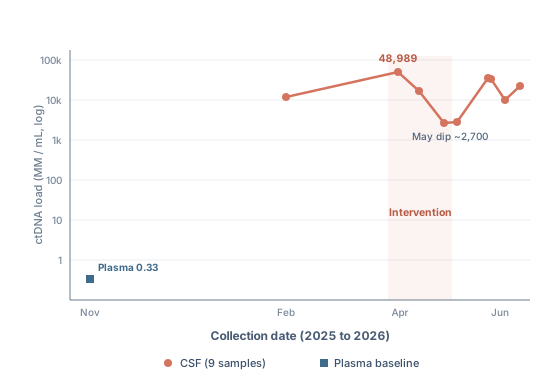
CSF on a single 16-variant panel gave 2,700 to 49,000 MM/mL across nine samples over four months, every one positive. The load tracked the treatment course, with the mid-May low around the time of an intervention and a rebound after; reading those dynamics is for the tumour board.
Tracking all 16 variants individually showed a polyclonal pattern, not a single escape clone: per-variant resolution that an aggregate score does not give.
Tiny inputs were enough: one CSF sample read 11,592 MM/mL from just 1.5 ng of cfDNA, because the tumour fraction in CSF is high.
An earlier baseline plasma sample was near-silent (0.33 MM/mL), consistent with how little CNS tumours shed into blood. It was taken months before the CSF series, so treat it as context, not a head-to-head comparison.
- 27 days from tumour profile to a validated, bespoke panel. Single-variant detection ~0.01% VAF; aggregate ~0.001% (10 ppm).
What stands behind the CSF claim.
The validated chemistry is peer-reviewed, and the CNS application is documented in a case study with Epistamai Bio. Each link goes to the source.
Epistamai Bio: tracking glioma in CSF.
Nine CSF timepoints, 2,700 to 49,000 MM/mL on one 16-variant tumour-informed panel; an earlier plasma baseline was near-silent.
SiMSen-Seq: the chemistry behind the CSF read.
Ståhlberg A, et al. Simple, multiplexed, PCR-based barcoding of DNA enables sensitive mutation detection in liquid biopsies. Nature Protocols. 2017. DOI: 10.1038/nprot.2017.006.
The full peer-reviewed record, filterable by indication.
Every SiMSen-Seq ctDNA paper, each linked to the version of record. Filter for the indications closest to your CNS programme.
"Treatment response monitoring in glioma remains highly limited, particularly in patients with diffuse or leptomeningeal disease where imaging can be difficult to interpret and where therapeutic decisions often need to be made before clear radiographic changes are available. The hope is that a CSF-based personalised ctDNA monitoring approach can provide a more dynamic readout of tumour burden and clonal evolution, enabling novel therapies to be tested and adapted more rationally over time."
Imran Chaudhry, MD · Epistamai Bio
From a tumour profile to a longitudinal CSF ctDNA report.
The same workflow whether you send samples to our lab in Gothenburg or run SiMSen-Seq in-house on LabSuite.
Tumour profile in
FFPE or fresh-frozen tumour, or an existing mutational profile (VCF, spreadsheet or FASTQ). A matched germline control is strongly recommended.
Personalised panel
We design and validate a tumour-informed panel of patient-specific SNVs and indels, typically 20 to 30, and up to 50, then reuse it at every timepoint.
CSF sampling
CSF from a puncture or shunt, with matched plasma where it adds value. We recommend 1 to 5 mL, frozen on dry ice or in a Streck tube (the grey-cap cell-free nucleic acid BCT suits smaller volumes; the tan-cap cfDNA BCT also works). From a puncture, 0.1 to 0.2 mL can be enough.
Longitudinal report
A clinical PDF with per-variant mutant molecules per mL (MM/mL), plus VAF and cfDNA input for context, an aggregated ctDNA load per sample, and a timeline across all timepoints. Raw data shared in parallel.
When CSF is not the right sample.
| CSF collection means a lumbar puncture or shunt access, which is more involved than a blood draw and is not appropriate for every patient or every timepoint. Tumours that do not abut the CSF spaces may shed less into the fluid, and a tumour-informed approach still needs a tumour sample to design the panel. For high-shedding systemic disease, plasma may be the better or sufficient sample, and we will say so. We keep honest comparisons on the Methodology page, and the four-question decision guide takes two minutes. |
Questions neuro-oncology teams ask us first.
-
How much CSF do you actually need?
Less than you might expect. We recommend 1 to 5 mL where you can get it, which suits shunt access and lets a Streck tube reach its intended fill volume. From a lumbar puncture, under 1 mL is common, and because CSF has a high tumour fraction, as little as 0.1 to 0.2 mL can work. More is always better, and our team will confirm against your collection route and tube before you ship.
-
How should CSF be collected, stored and shipped?
Two routes work well: freeze the CSF on dry ice, or collect it into a Streck tube. We normally use the tan-cap cfDNA BCT; the smaller grey-cap cell-free nucleic acid BCT is a good option for the lower volumes a puncture gives, and both perform well. To fill a Streck tube to its intended volume you will usually need shunt access rather than a single puncture. We provide written instructions and walk your site through them before the first sample.
-
Why do you report mutant molecules per mL rather than VAF?
Because a fraction depends on the background. Variant allele frequency is the share of DNA that is mutated, so it shifts when a sample carries more wildtype DNA, for example from sample handling. Mutant molecules per mL is a direct count of tumour molecules, so it stays robust when the background changes. The two are usually closely correlated; we report both and lead on MM/mL.
-
Do you need an ultra-sensitive assay for CSF?
Less than in blood. CSF usually has a higher tumour fraction than plasma because there is so little background DNA, so detecting a vanishingly rare variant is not the main challenge here. The value in CSF is sampling the right compartment, working from a small, low-DNA sample, and quantifying it cleanly as MM/mL. The same chemistry is ultra-sensitive when you do need it, for example in matched plasma.
-
Should we send CSF or plasma for a CNS tumour?
For CNS-confined and leptomeningeal disease, CSF is usually the more informative sample because the tumour sheds into it directly. Where there is systemic disease as well, plasma adds value, and the personalised panel runs on both. We are happy to advise on the right compartment, or combination, for your cohort.
-
Our tumour is a low-grade glioma with few structural variants. Can you still build a panel?
Yes. The panel is designed around somatic SNVs and indels identified from exome or targeted sequencing, so it does not depend on structural-variant burden. That makes it applicable to stable-genome CNS tumours, including low-grade gliomas, where an SV-based approach can run short of markers.
-
Can we run CSF ctDNA in our own laboratory?
Yes. Simsen LabSuite ships the personalised panel, reagents and bioinformatic software so your team runs the full SiMSen-Seq workflow in-house on your own Illumina sequencers, with identical chemistry and identical validated performance. Samples and data never leave your environment.
This page is general information for clinical and research professionals. It is not clinical advice or a diagnostic claim. The right approach for a given case also depends on tumour type, available markers, sample quality and your specific endpoint. For a considered recommendation, talk to our scientific team.
Designing a CNS or leptomeningeal study? Let's talk CSF samples.
A real human, in CET/CEST time zone, who has run CSF and plasma samples like yours.